I think travel is about discovering new places and learning about new cultures. Part of the discovery is learning to appreciate other people’s culture and respect the way they do things, their beliefs, and all aspects of their culture. One of the best ways to learn about people is to explore their cuisine.
On our visit to Bonaire in September 2015, John and I stayed at Divi Flamingo Beach Resort & Casino. The hotel had just completed a multi-million dollar renovation project that included an upgrade to both pools. My favorite place to spend time was around the largest pool relaxing in one of the curtained cabanas. The pool had underwater music.
The island is a semi-arid desert where iguanas are plentiful. Wildiguanas are indigenous to Mexico, Central America, parts of South America and some Caribbean islands like Bonaire. There are feral iguanas in California, Florida and Hawaii. Iguana Soup is a favorite of the local people claiming it is a cure-all for just about any malady plus it is an aphrodisiac, which seems to be the most common attribute given to unique foods. I liken eating iguana to people in parts of the United States who eat rabbits, squirrels, and frogs. Iguanas are free for the capturing.
One day we visited the historic village of Rincon in the northern part of the island. The village is in a valley where it was safe from seafaring marauders. We stopped by Posada Para Mira restaurant overlooking Rincon. Their menu included many local favorites such as goat stew, conch soup, and iguana soup.
After our return from Rincon we chatted with Divi’s general manager, Charles Vos, and mentioned that we saw iguana soup on the menu of Posada Para Mira. He said iguana meat tastes like chicken. Laughingly, I said it seems that is the usual comment when describing the taste of exotic food. He said his chef would gladly show us how iguana soup is made even though it is not on the hotel’s menu.
A few days later Mr. Vos said that Lucio Mercera, the sous chef, had an iguana and was ready to show us how the soup is prepared. Iguana Soup sounds more exotic than it tastes. The tender meat had less flavor than chicken and the broth tasted like Knorr’s soup. It is very boney. I did a quick check on the internet and found iguana meat can be purchased from Exotic Meat Market, www.exoticmeatmarket.com.
Iguana Soup
1 iguana, ready to cook (skinned, gutted)
½ (half) cup lemon juice
½ (half) cup vinegar
1 tsp salt
Water – as needed
½ (half) large onion, diced
2 stalks celery, diced
1 green pepper, diced
1 large tomato, diced
2 carrots, diced
4 cloves of garlic minced
1 box Knorr’s instant noodle soup mix
1 tsp minced basil leaves
Cut the iguana into two-inch pieces with spine removed. Place in pot and cover with two inches of water. Add lemon, vinegar, and salt. Stir and let sit for 5 minutes. Drain. Cover with two to three inches of water. Bring to a boil. Cook over medium heat until iguana is tender – about one hour. Add vegetables, garlic, and soup mix. Bring to a boil, reduce heat to medium, and cook five to ten minutes or until vegetables are tender. Garnish with minced basil leaves. Serve. Watch out for the small bones.
In the 1700s Haiti was the glory of the French colonies and one of
the richest colonies in the world. In 1804 Haiti became the first black independent nation. Over the years, poor leadership and other issues caused economic troubles from which Haiti has never fully recovered and the earthquake in 2010 only exasperated the problem. When John and I visited Haiti in October 2013 we were impressed with the diversity of things to see and do. All the places we visited are hoping that an increase in tourism will lead to economic growth.
We visited the Citadel, a World Heritage site high on a mountain,
and on the way up the mountain we stopped at the ruins of San Souci, a Versailles-like palace that was the royal residence of King Henry I. Yes, there was once a king of Haiti. It is also a World Heritage site.
I had expected beaches and I was not disappointed. One of my favorite places was Jacmel where there are not only great beaches but shops with great local artwork created out of whatever was handy. I was especially impressed with Charlotte, a shop that displayed colorful works of art made of gourds and reeds.
In Jacmel we stayed at La Colline Enchantee,
(www.la-colline-enchantee.com) where rates for a double room ranged from $77 to $99 per night. The lovely eco-resort is high on hill just outside of the Jacmel.
The owner Michele Gehy was very friendly and, like all the Haitians
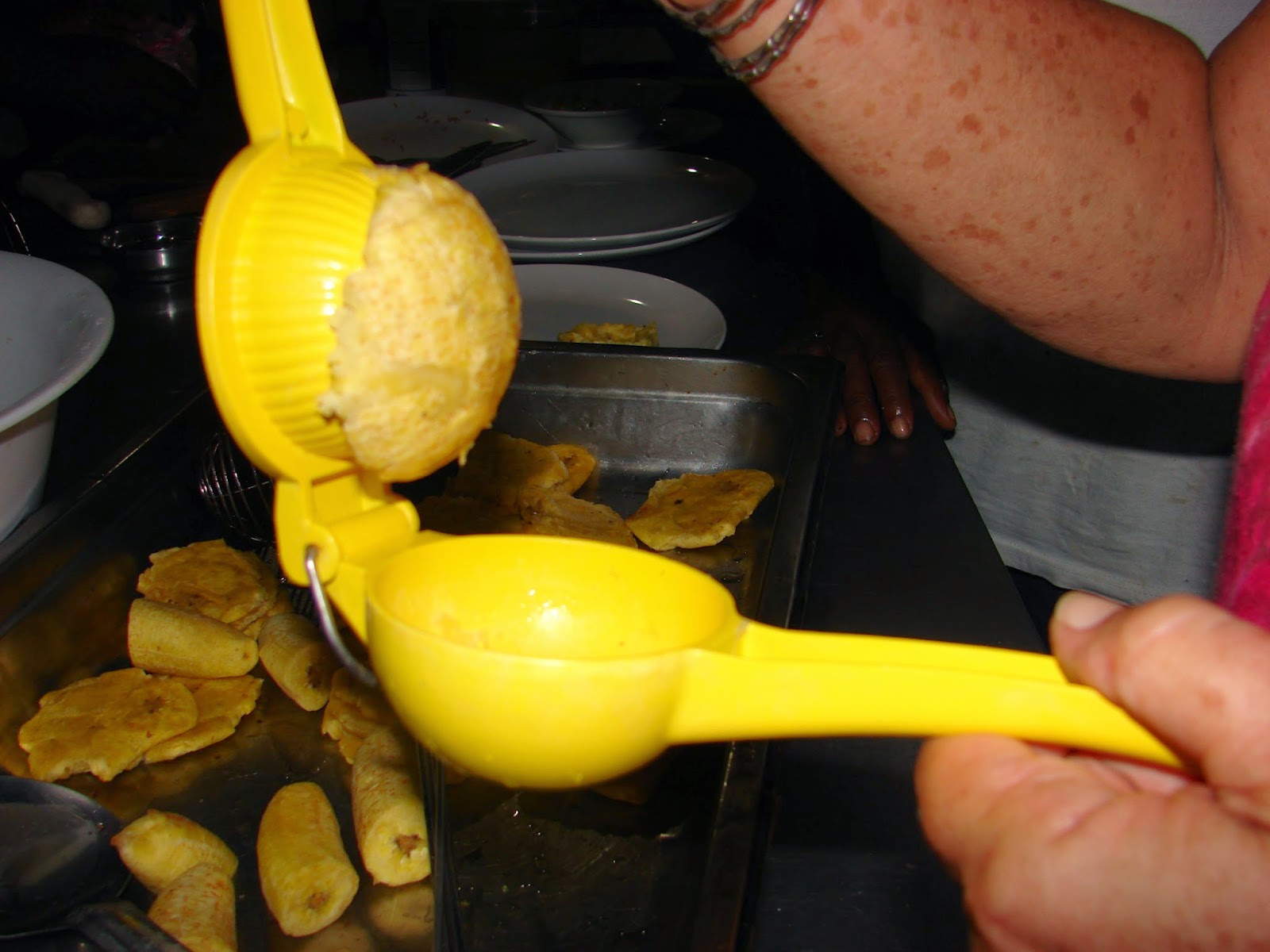
we met, proud of their country. While we were talking about Haitian food she mentioned that plantains are the “Haitian potato.” I told her I had tried the Plantain Fritas and would love to know how to make them because they are not only delicious but would make great hors d'oeuvres. She said, “Do you want to know how to make them? Come with me and I will show you.” We went into the kitchen where she proceeded to show us how to make Plantain Fritas– gratis. The Griot de Porc can be made ahead of time, refrigerated and reheated when ready to put in plantain cups and serve.
Plantain Fritas
Griot de Porc
1 lb of pork
Juice of 2 limes
1 cup orange juice
2 onions thinly sliced
1 green pepper thinly sliced
4 to 6 cloves
5 cloves of garlic
One-fourth tsp thyme
One-fourth tsp salt
One-fourth tsp black pepper
Water as needed
This can be made ahead of time. Cut the pork into small cubes (keep the fat). Make a marinade of the lime juice, orange juice, half of the onions, green pepper, cloves, garlic, thyme, salt and black pepper. Marinate pork in marinade overnight in refrigerator (or at least four hours). Put it all in a sauce pan. Boil on low heat for about 20 minutes. Add water if necessary. Drain. Add rest of onions. Saute over medium heat until brown. Put in the plantain baskets and serve. It can be spiced up according to personal taste.
Fried Plantain Baskets
4 green plantains
2 cups water
1 teaspoon salt
2 lemons
2 tbs vegetable oil for frying – or as needed
Peel the plantains. Cut into pieces two inches long. Place in water with salt and juice of lemon for two hours. Remove and drain on paper towels. Heat the oil in a frying pan. Cook plantains for two to three minutes. Remove plantains. Drain on a paper towel. Press the fried plantain pieces in a lemon press of similar device to make the small cup-like baskets. Put them back in the salt and lemon water for a couple minutes. Remove and drain on a paper towel. Fry in oil until crispy. Fill with Griot de Porc and serve.
 I think travel is about discovering new places and learning about new cultures. Part of the discovery is learning to appreciate other people’s culture and respect the way they do things, their beliefs, and all aspects of their culture. One of the best ways to learn about people is to explore their cuisine.